Exploring emergent phenomena of quantum materials arising from
spontaneous symmetry breaking — through theory.
Research
Research
Combining symmetry techniques with microscopic response theory to explore emergent phenomena from ordering.
Research topics
Optical properties involving quantum orders
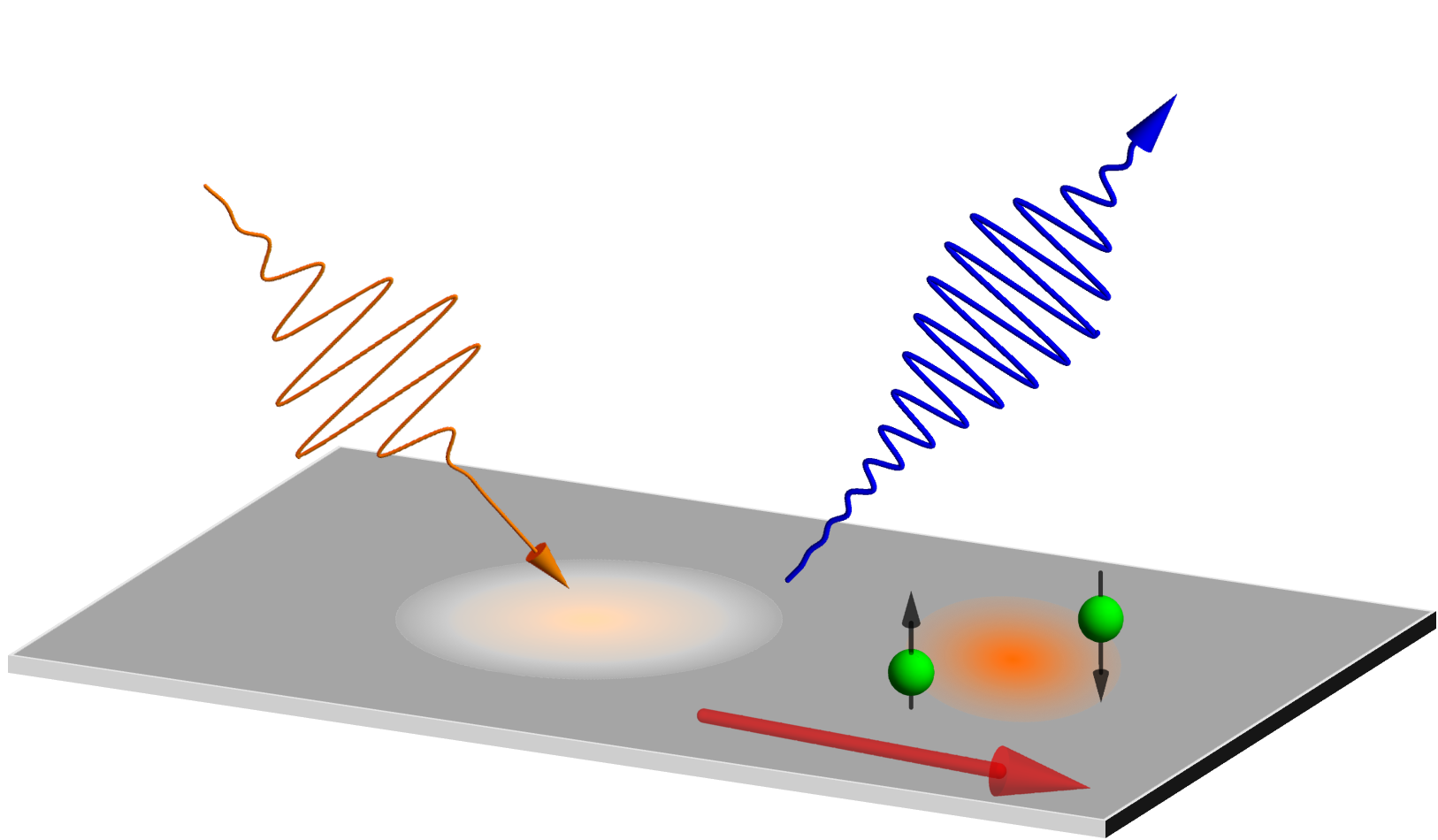
Cooper-pair condensation in superconductors gives rise to unusual optical responses.
Building on a microscopic theory, we predicted peculiar nonreciprocal nonlinear optical responses
in superconductors with broken inversion symmetry — responses that require no quasiparticle generation and
diverge in the low-frequency limit, promising low-dissipation nonlinear optical devices and probes of quantum geometry.
We also study nonlinear responses driven by emergent fields of spin dynamics in odd-parity antiferromagnets. Refs:PRB(2022),
PRB(2024),
PRL(2026).
Nonreciprocal optical responses of a superconductor.
Exploring versatile antiferromagnets
We were among the first to focus on the physics of magnetic parity violation and its coupling to conduction.
Using electromagnetic multipoles and representation theory, we systematically classified macroscopic
electromagnetic anisotropy, unifying ferroic and antiferroic order. For orders that break inversion symmetry
(odd-parity magnetic multipoles), a duality between time-reversal and space-time-reversal symmetry
proves powerful. We further predicted the magnetopiezoelectric response (later confirmed experimentally)
and developed a spin-crystallographic-group framework for phenomena without spin–orbit coupling. Refs:Review(2024),
PRB(2024),
Nature(2026).
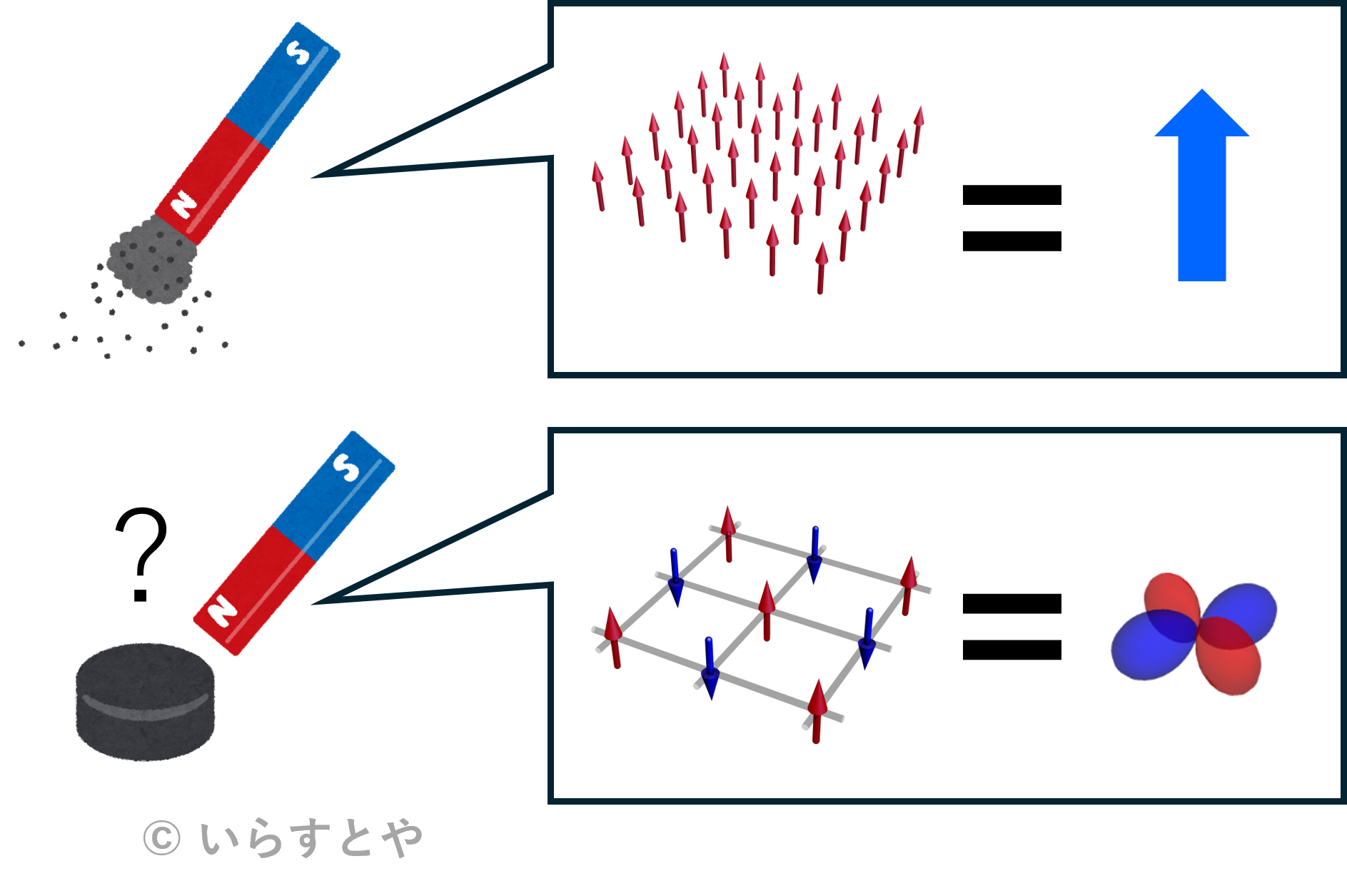
Antiferromagnets carry no magnetization but host multipoles.
Visualizing hidden orders
Space-time-reversal-symmetric antiferromagnets show neither magnetization nor structural asymmetry, making their order hard to detect.
We proposed nonreciprocal electrical responses — diode-like (photo)currents whose rectification direction follows the
antiferromagnetic order — as a way to read out such hidden order. We also explained and predicted Raman optical activity
of ferroaxial order together with experimental groups at Institute of Science Tokyo and the University of Tokyo. Refs:PRX(2021),
PRB(2025),
PRL(2026).
Raman optical activity of a ferroaxial / chiral material.
The full list of publications is available on the Activity page.